
Why I Need to See Your Home Before I Tell You What It’s Worth
One of the most common questions I get from homeowners who are thinking about selling is:
“Can you tell me what my house is worth?”
Absolutely.
I can pull recent sales, look at what’s currently for sale, check what’s under contract, study your neighborhood, and compare your home with similar properties.
In fact, I usually do quite a bit of that research before I ever walk through your front door.
But if you want my best opinion of what your home could realistically sell for, I need to see the house.
Inside and outside.
The numbers give me a starting point. Your actual property helps me understand what those numbers mean for your home.
That’s why I consider a Comparative Market Analysis (CMA) an important first step, not the entire valuation process.
What Can I Learn About Your Home Before I See It?
Quite a bit, actually.
When I begin researching a property, I can usually find information such as:
Square footage
Number of bedrooms and bathrooms
Lot size
Age of the home
Previous sales information
Tax information
Recent nearby sales
Homes currently competing for buyers
Pending sales
Some previous listing photos and descriptions
That information gives me a foundation.
I can start identifying comparable properties, often called comps, and see what buyers have recently paid for homes that appear similar to yours.
This is the basis of a Comparative Market Analysis.
If you're wondering exactly how a CMA works, I explain the process in What Is a CMA in Real Estate? A Missouri Home Seller's Guide.
But here's the problem:
Your house doesn't exist on a spreadsheet.
Two houses can look almost identical in the data and feel completely different when you walk through the front door.
Why Isn't a CMA Alone Enough?
Let's say I'm comparing two homes in Blue Springs.
They're in the same neighborhood.
Both have four bedrooms, three bathrooms, about 2,400 square feet, a two-car garage, and similar-sized lots.
On paper, they look like excellent comps.
Then I see them.
One has an updated kitchen, newer flooring, fresh paint, a beautifully finished basement, and a covered patio overlooking a private backyard.
The other has the original kitchen, worn flooring, several deferred maintenance items, an unfinished basement, and a backyard facing a busy road.
They're still similar houses.
But are buyers going to view them as equally valuable?
Probably not.
That's the information I can't fully get from public records or an automated home-value estimate.
I need to see it.
Updates Matter, but Not Every Update Adds the Same Value
This is another reason I like walking through the home with the seller.
You know what you've done to your house.
I don't.
Maybe you've:
Replaced the roof
Installed new windows
Remodeled the kitchen
Updated the bathrooms
Finished the basement
Replaced the HVAC system
Added a deck or covered patio
Installed new flooring
Added a shop or outbuilding
Improved fencing
Made substantial landscaping improvements
Some of those things may affect how buyers perceive your home and how it compares with recent sales.
But I also don't want to simply add up what you've spent and tack it onto the home's value.
Unfortunately, home improvements don't work that way.
A $30,000 project doesn't automatically make a house worth $30,000 more.
That's where seeing the improvements and comparing them with what buyers are paying for similar properties becomes important.
Condition Matters More Than a Computer Can See
Sometimes it isn't a major renovation that makes a difference.
It's the overall condition.
There is a noticeable difference between a home that has been carefully maintained and one where repairs have been put off for years.
I may walk into your house and notice that you've taken excellent care of it.
The paint is clean. The flooring is in good condition. The doors work properly. The trim isn't beat up. The landscaping is maintained. Nothing feels neglected.
That matters.
On the other hand, I may see several things buyers are likely to notice immediately.
That doesn't mean you need to panic or remodel the entire house.
Sometimes a handful of relatively inexpensive improvements can make a meaningful difference in how the home shows.
That's one reason I like doing this before a seller starts spending money.
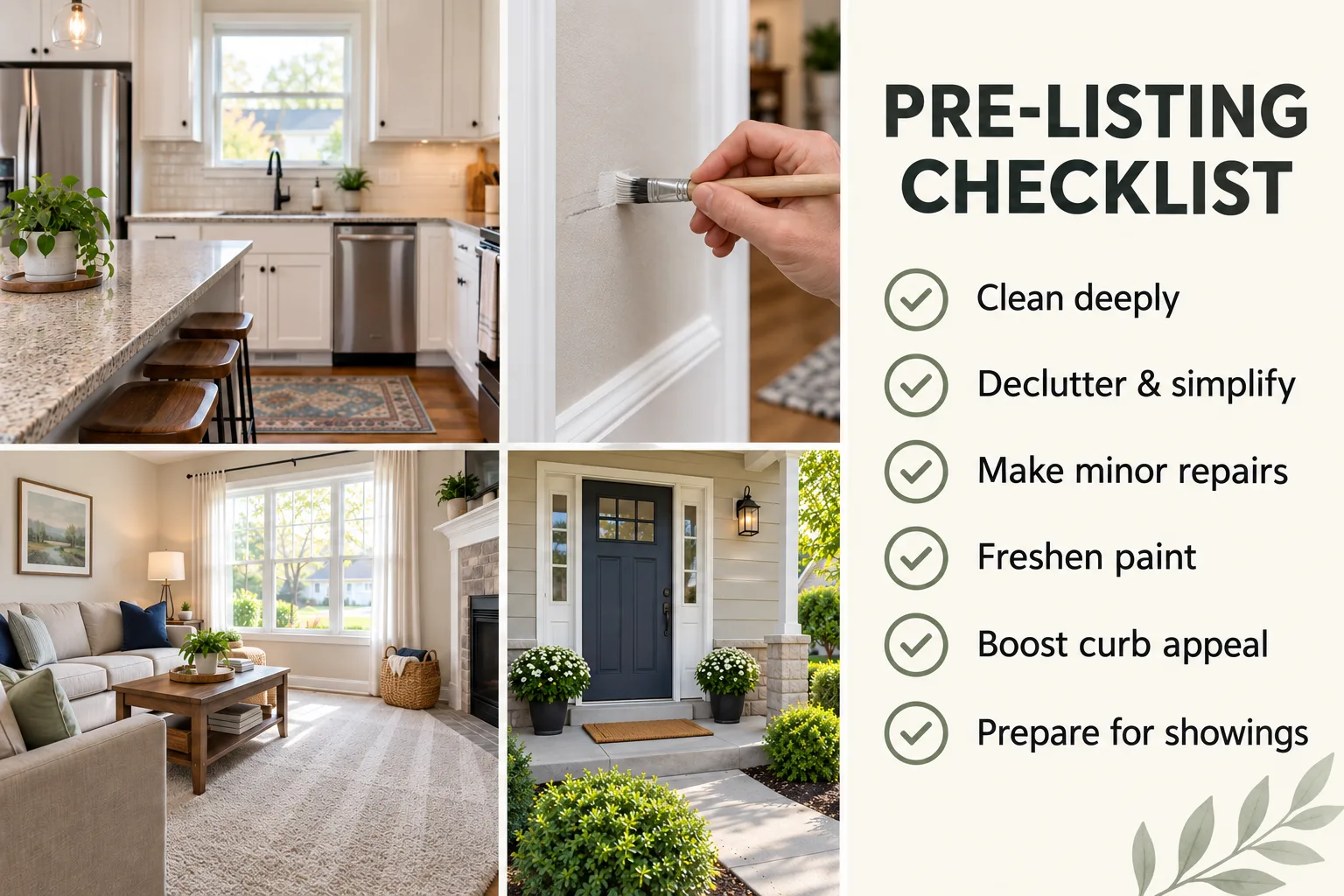
If you're beginning to prepare your house for sale, my Pre-Listing Checklist can help you figure out where to start.
And when I come through the house, I'll tell you what I think is worth addressing and what I think you can leave alone.
I'm not interested in spending your money just to make a to-do list longer.
Layout Doesn't Always Show Up in the Numbers
Square footage tells me how much space a house has.
It doesn't tell me how that space feels.
Two 2,000-square-foot homes can live very differently.
One may have an open layout with great natural light and rooms that make sense.
The other may have awkward additions, a tiny kitchen, unusual room placement, or spaces buyers aren't quite sure how to use.
That doesn't necessarily make one a bad house.
But it can affect how buyers respond to it.
The same thing applies to basements.
“Finished basement” can mean a beautiful additional living area with a family room, bedroom, bathroom, and great natural light.
It can also mean some paneling and carpet were installed 30 years ago.
Those aren't necessarily the same thing in a buyer's eyes.
Location Gets More Specific Than a ZIP Code
I can see where your house is on a map.
But sometimes I need to stand there to really understand the location.
Maybe your backyard backs to trees.
Maybe you have a beautiful view.
Maybe you're on a quiet cul-de-sac.
Maybe the lot feels much larger and more private than it looks online.
Those can be positives.
There can also be things that affect buyer perception in the other direction.
Maybe the house backs to a busy road. Maybe there's commercial property nearby. Maybe parking is difficult. Maybe neighboring properties affect the overall feel.
Two homes a few streets apart can have very different settings.
That's another reason I don't want to value your house solely from my computer.
Rural Properties and Acreage Make This Even More Important
This is especially true with the rural and acreage properties I work with around eastern Jackson County, Johnson County, Lafayette County, and the surrounding areas.
A listing may tell me:
5 acres. Barn. Fenced.
Great.
But that leaves me with a lot of questions.
What kind of five acres?
Is the land flat and usable?
Is most of it wooded?
Does it stay wet?
How is it fenced?
What condition is the fencing in?
Is the barn actually usable?
Does it have electricity?
Water?
How big is it?
Could someone comfortably keep horses or livestock there?
Is there a shop?
What kind of access does it have?
How private does the property feel?
If I'm helping value a rural property, those details can matter tremendously.
I can find another house with five acres and a barn and call it a comparable.
But until I understand your five acres and your barn, I don't know how comparable those properties really are.
This is one area where firsthand knowledge matters.
What About Zillow and Online Home Value Estimates?
Online estimates can be useful if you're simply curious.
They're quick, easy, and based on available data.
But they have the same limitation we've been talking about throughout this article:
They haven't been inside your house.
An algorithm doesn't know that you remodeled your kitchen last year unless the data somehow reflects it.
It doesn't necessarily understand that your shop is unusually nice, your backyard has incredible privacy, or your house has been maintained beautifully.
It also may not understand something that works against the property.
That's why I wouldn't make a major financial decision based entirely on an automated estimate.
Use it as information.
Just don't assume it's the whole answer.
Does Seeing the House Mean I Can Tell You Exactly What It Will Sell For?
No, and I think it's important to be clear about that.
Even after I've researched the market and walked through your property, I'm still developing an informed opinion of where your home fits in the current market.
Ultimately, buyers determine what they're willing to pay.
Market conditions can change. Competition can change. Interest rates can affect buyer activity. Another similar house can come onto the market the same week we do.
There are variables none of us control.
What I can do is gather as much relevant information as possible so we're making an educated decision rather than guessing.
That's very different from typing your address into a computer and handing you a number.
Market Value and Listing Price Aren't Exactly the Same Thing
This is another distinction that's important.
Once we've done the research, walked through the property, discussed its condition and improvements, and looked carefully at the comparable sales, we should have a much clearer picture of where the home fits in the market.
Then we decide how to price it.
Those are two separate steps.
Maybe current inventory is extremely limited.
Maybe several similar homes are competing with us.
Maybe buyers are moving quickly in your price range.
Maybe they're being more selective.
All of that can influence our pricing strategy.
I go much deeper into this in How to Price Your Home Strategically in the Eastern Kansas City Metro.
Think of it this way:
The CMA gives us the data.
Seeing the property gives us the context.
Pricing strategy brings those pieces together.
What Happens When I Come Look at Your House?
This doesn't need to be intimidating.
Please don't feel like your house has to be spotless before I'll come over.
And you definitely don't need to start remodeling before I get there.
Actually, I'd rather you didn't start spending a bunch of money first.
I want to see the house as it is.
We'll walk through it together. You can tell me about updates you've made, things you love about the property, improvements that may not be obvious, and anything you think I should know.
I'll look at the inside, outside, lot, condition, features, and anything else that may affect how we compare your home with other properties.
Then we can talk honestly about what I see.
There may be a few things I recommend doing before listing.
There may be things you've been worried about that I tell you aren't worth spending money on.
And sometimes I'll walk through and say, “You really don't need to do much at all.”
Every house is different.
That's the whole point.
You Don't Have to Be Ready to Sell Yet
I think this is worth saying because homeowners sometimes hesitate to call a real estate agent until they've officially decided to sell.
You don't have to be there yet.
Maybe you're thinking about moving next year.
Maybe you're trying to decide whether selling would give you enough equity for what you want to do next.
Maybe you're considering downsizing, buying acreage, moving closer to family, or simply wondering whether now is the right time.
Knowing what your home may realistically be worth can help you make those decisions.
I'd much rather give you useful information while you're figuring things out than have you spend six months making improvements you didn't need to make.
Wondering What Your Home Is Really Worth?
If you're curious, here's how I prefer to do it.
I'll research your property and the market before I come out, so I already have a good understanding of the numbers.
Then I'll come see the house and property for myself.
We'll walk through it together, talk about improvements and condition, and look at the things a database simply can't show me.
Then I can take what I've seen and put it together with the market data to give you a much more informed picture of where I believe your home fits.
No computer-generated number can replace that.
And you don't have to be ready to put a sign in the yard.
Sometimes you just need good information before you can decide what comes next.
If you're considering selling in Blue Springs, Lee's Summit, Grain Valley, Independence, Oak Grove, Lone Jack, or the surrounding eastern Kansas City area, you can learn more about how I work with homeowners on my Seller page or contact me when you're ready to talk.